

Comma pumps, impossible musical figures, and holonomy
Tuning musical instruments is weird and beautiful and fascinating and complicated and annoying. For as long as people have been thinking about how music works, they’ve been wrestling with various incarnations and shadows of something that feels like an impossibility theorem. One of the earliest such results, which dates back to both ancient Greece and ancient China, is the fact that is almost but not quite equal to . The ratio is called the Pythagorean comma. It’s the frequency difference between a stack of 12 perfectly tuned fifths (with frequency ratio ) and 7 perfect octaves (with frequency ratio ). Intervals are sometimes measured in cents, which are a logarithmic scale with 1200 steps per octave; the Pythagorean comma is about 23.46 cents. Under the standard equal-temperament tuning system, if you follow a sequence of twelve perfect fifths, you end up at a note seven octaves above where you started, hitting all notes of teh chromatic scale along the way; this is the circle of fifths. But if these perfect fifths were tuned exactly, you would end up a Pythagorean comma above the note we would expect. In fact, this is one reason why we have enharmonic names for notes. In Pythagorean tuning, B# is not the same as C, because B# is a stack of 12 perfect fifths above C.
Comma pumps
One of the downstream effects of this inconsistency (noticed at least by the 17th century) is the existence of comma pumps. A comma pump is a chord progression—starting and ending on the same chord—that forces the pitch center to shift by a comma if performed in just intonation. Performing the sequence of chords with each one tuned correctly, you’ll nominally return to the original chord but the pitches will all be slightly higher or lower than the first time it was played. Online sources don’t usually do a great job of explaining how this works, either making it sound too complex or mystical, or ignoring the things that make it work. The thing that makes a chord progression force a comma pump (rather than just slowly drifting out of tune) is common-tone voice leading. If you play one chord followed by another, and those chords have some notes in common, you should probably play the shared notes at exactly the same pitch. If those chords have fixed tunings (e.g. major triads are correctly tuned when the frequencies of their pitches form the ratio ), the pitches of all the remaining notes are determined by their relationship with the shared notes. So in just intonation, a sequence of chords where each adjacent pair shares at least one note leaves no choices about where the tuning ends up.
As an example, let’s look at the chord progression Cmaj-Fmaj-Dmin-Gmaj-Cmaj (I-IV-ii-V-I in C major). We’ll consider the ratio of the root of each chord to our initial C as we move along the progression:
- Fmaj (F-A-C) shares the pitch C with Cmaj (C-E-G), so the root of Fmaj needs to be a perfect fourth above or a perfect fifth below C; that’s a ratio of .
- Dmin (D-F-A) shares both F and A with Fmaj, so its root should be a minor third below (or major sixth above) F, a ratio of .
- Gmaj (G-B-D) shares the pitch D with Dmin, so its root needs to be a perfect fourth above D, another .
- Finally, Cmaj shares the pitch G with Gmaj, so its root needs to be a perfect fifth below G, a ratio of .
Multiplying these all together we have (-21.51 cents). The C we come back to at the end of the progression is slightly lower in pitch than the one we start with! The difference here is called the syntonic comma, usually defined as the difference between four perfect fifths and two octaves plus a major third .
Here’s what this progression sounds like in just intonation:
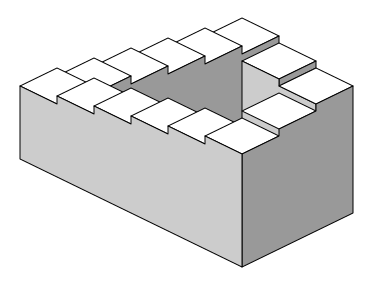
The descent is not subtle (a longer progression would probably make it harder to detect), but it’s hard to decide exactly where things go wrong. It’s like the inverse of the Penrose staircase: instead of descending a continuous downhill path and somehow returning back to the same spot, you follow a path that’s supposed to loop back to the beginning and find yourself slightly lower than you started.
Holonomy
If you’re like me, impossible figures should make you think about algebraic topology. If comma pumps are like musical impossible figures, is there a topological interpretation? Here’s one approach: given a set of chords, we can form a voice leading graph where we have one vertex for each chord, and an edge between any two chords that share a note. (Or, if you want to be pickier, you can require them to share two notes.) Paths in this graph are admissible chord progressions, and a cycle is a chord progression that returns to the original chord. If we now assign each chord a tuning, we can annotate each (oriented) edge by the frequency ratio between their roots induced by the choice of tuning.1 This is a gadget with many different names. You could call it a gain graph with gain group . Or you could think of this data as providing an element of . Or, somewhat less precisely but more evocatively, you could think of this as a flat connection for a discrete fiber bundle with structure group . You could even construct a cellular sheaf from this data, although it turns out that’s less convenient to work with.
The point is that now every loop in the graph (i.e. any chord progression) has an associated holonomy (i.e. a change in root pitch frequency) given by taking the product of the root ratios for every edge it traverses. This gives us a map ; since the target is abelian this map factors through and is determined by its values there, so we may as well just descend to homology. Any chord progression that is not a comma pump is in the kernel of this holonomy map. So classifies the possible comma pumps for a given family of chords.
This algebraic fact gives us some additional insight into how many comma pumps can exist. Just intonation tuning is often performed in a prime limit, which restricts the prime factors that can appear in the numerator and denominator of a pitch ratio. 5-limit just intonation allows for factors of 2, 3, and 5. This means that all frequency ratios involved live in a subgroup of , one isomorphic to , with one factor for each prime. The mathematical tuning community, for its own whimsical reasons, has decided to call this representation the group of monzos, and writes elements of this group as kets whose entries are the exponents of each prime: for example, represents as a 5-limit monzo. It’s also common to ignore octave differences, meaning we take the quotient , or just drop the first factor of . Let’s call our prime-limit monzo subgroup with octave equivalence , since we can think of it as a lattice.
By construction, the map is injective. So there are at most independent comma pumps. A chord family tuned in 5-limit JI can have at most two independent comma pumps, a family tuned in 7-limit JI can have at most three, and so on. Note that is generally not surjective. If it were, it would mean that there is a single chord progression that when followed, results in a root pitch that is, say, a perfect fifth above the starting point. (The quotient can be thought of as a temperament: it collapses the commas into unisons. This is one of the central pieces of mathematical tuning theory.)
Geometric realizations
Sometimes, it is possible to find a nice family of 2-cells whose boundaries span , giving us a cell complex with 1-skeleton such that is the space of comma pumping chord progressions. The generating cells should be bounded by something like minimal comma-free chord progressions. This is the case for the triads of the major diatonic scale.2 They form a graph like this:
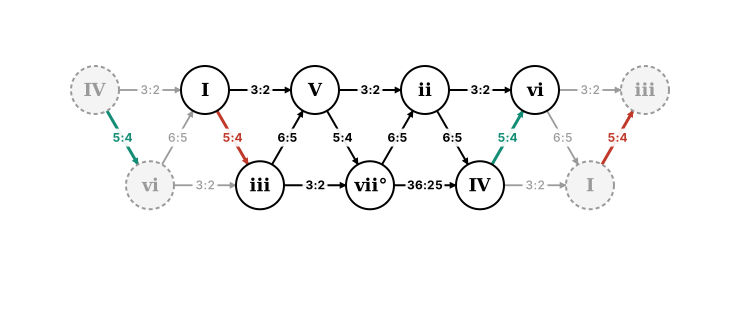
Each of the triangles in this graph can be filled in (to check this, just multiply the ratios around the boundary, taking into account orientation; or note that any chord progression where there is a common tone shared by all chords must be holonomy-free). Gluing the ends together gives us a Möbius strip, which has . So there is at most one class of comma pumps within this family of chords. In fact, our comma pump from earlier is here: it’s I-IV-ii-V-I in C major. Multiplying ratios along the path gives the descending syntonic comma . Every comma pump progression you can generate with this set of chords moves the root pitch by the syntonic comma (or a power thereof). For instance, you can follow the circle of fifths-like progression I-IV-vii°-iii-vi-ii-V-I. This progression never repeats a chord, but it pumps . This is because it’s a cycle that follows the boundary of the Möbius strip, which is twice a generator of .
What if we look at all major and minor triads on the chromatic scale? To keep the drawing simple, we’ll only allow voice leading between chords with two shared notes.3 (Note that we are assuming enharmonic equivalence here, which is again not typically how just intonation theory works.)
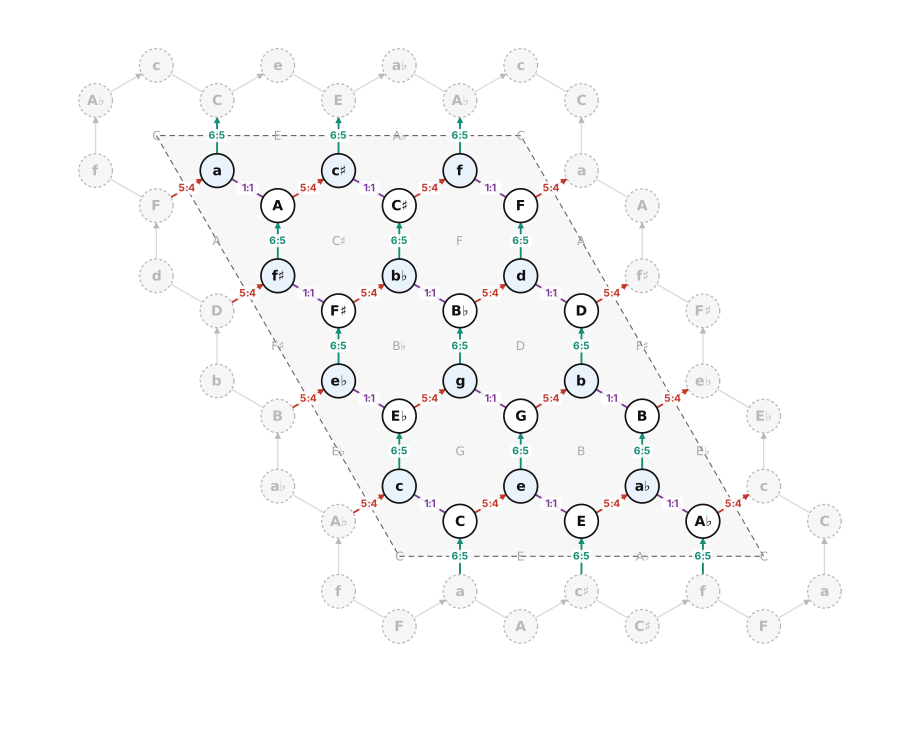
This is the dual graph of Euler’s Tonnetz, a triangular lattice where vertices correspond with notes and 2-simplices correspond with chords. There are two root intervals available (three if you count the unison between the major and minor chord on the same root): a minor third and a major third. The natural dual cell structure combined with enharmonic and octave equivalence makes this into a torus. This again lets us conclude that there are at most two independent comma pumps available. And there are two independent comma pumps:
- Amaj-Amin-Fmaj-Fmin-C#maj-C#min-Amaj pumps (41.06 cents). This is the (lesser) diesis or augmented comma, the difference between a stack of three major thirds and an octave.
- Cmaj-Cmin-Ebmaj-Ebmin-F#maj-F#min-Amaj-Amin-Cmaj pumps (62.57 cents), which is the greater diesis or diminished comma. This is the difference between a stack of four minor thirds and an octave.
The monzos are linearly independent, and we can see on the diagram that the corresponding comma pumps are independent generators of .
These comma pumps are not too surprising—the chord roots move uniformly in major or minor thirds. But where’s the syntonic comma? Well, . (Or equivalently in cents, .) Because is a group homomorphism, we can construct a chord progression that pumps the syntonic comma by addition in : subtract the progression that pumps the augmented comma from the progression that pumps the diminished comma. Then we can produce a simplified homologous cycle by homotopy across 2-cells. One example progression would be Cmaj-Emin-Gmaj-Bmin-Dmaj-Dmin-Fmaj-Amin-Cmaj.
What else?
There are a lot of other interesting questions to ask inside this framework; maybe I’ll do some of them next:
- More exotic chord families. For instance, what happens when you introduce chord families with harmonic sevenths (as in barbershop music)? Chords from symmetric scales like the diminished scale?
- Alternate chord tunings. Performers may want to select tunings on the fly to avoid the possibility of a comma pump. We could model this by adding a second complex of tunings that maps down onto our chord complex. The central question is then whether it is possible to lift a given cycle in the base complex to a holonomy-free one.
- Inverse problems. Are there methods to produce a chord family with no comma pumps, or a family that has progressions pumping a specific interval?
- Torsion. All the holonomy we see here generates a free subgroup of . The quotient doesn’t introduce any torsion here, but if we lift to there could be commas that when stacked equal an octave. The most likely way to get this is by tempering intervals to an EDO (equal division of the octave) scale that doesn’t temper out a particular comma.
-
There’s a subtlety here: once chords are assigned tunings, there’s a possibility that intervals fail to match between two chords that share more than one note. We can either require that all interval tunings be consistent, or remove edges where the tunings are inconsistent between the chords. ↩
-
There’s a bit of fussiness around the diminished vii° chord. There isn’t a standard just tuning of this chord, and to make this work out as a Möbius strip, I’ve chosen 25:30:36 (two stacked pure minor thirds), which is definitely not the tuning most people would reach for. If you use another tuning, the vii°-ii transition isn’t allowed because the intervals don’t match, so the complex ends up with a hole. This would normally introduce another generator to , but it turns out that another more complex 2-cell shows up in the kernel of $\Phi$ to kill that generator. ↩
-
If we allow voice leading with only one shared note, every 2-cell in the complex becomes a . Filling in all the higher-dimensional simplices gives a space that is homotopy equivalent to a torus, so all the same conclusions still hold, and the comma pumps are actually significantly simpler. ↩